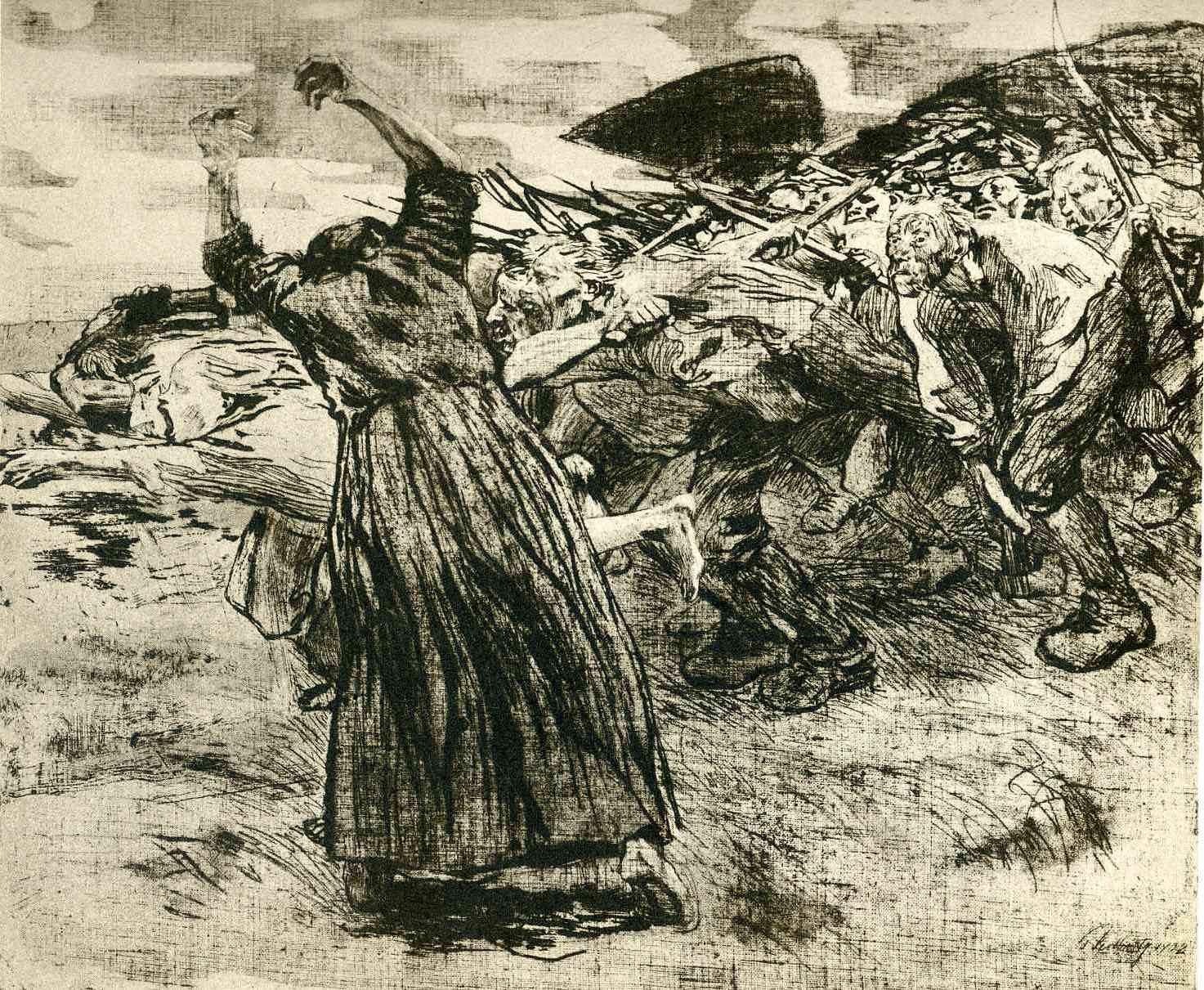
Kathe Kollwitz Peasants War. In kollwitz’s visceral intaglio, they. Her first masterwork was the cycle of three lithographs and three etchings depicting the silesian weavers' revolt of 1842, exhibited in 1898, followed in 1908 by the peasants' war cycle, six etchings depicting the sixteenth century rebellion of farmers in southern germany;
Catalogue raisonné of her prints, revised edition, published on cd by edition kornfeld bern, 2002: Käthe kollwitz, the grieving parents. Few artists are as universally beloved as the german printmaker, draftsman, and sculptor kathe kollwitz, whose powerful images of mothers and children and of protest against social injustice have long been admired by both critics and the public.
Etching, Drypoint, Aquatint, Lift Ground, Soft Ground, Pigment, And Ink On Paper.
Life, death and war’ in the national gallery of ireland, november 2017. Two giant granite figures on granite blocks. For example, an early major portfolio, peasants’ war (ca.
Sheet 3 Of The Peasants' War Series.
These prints truly encapsulate the beauty to be found in mass mobilisation. Käthe kollwitz is acclaimed for her poignant scenes of human suffering, especially the tragic consequences of poverty and disease among women and children. (wikimedia commons) (wikimedia commons) after the assassination of spartacus league leaders karl liebknecht and rosa luxemburg by the freikorps in 1919, kollwitz attended liebknecht’s funeral with thousands of supporters and became sympathetic to the communist party of germany.
She Initially Found Accommodation In Nordhausen (Thuringia), And From 1944 In Moritzburg Near Dresden.
Käthe kollwitz, “charge” (between 1902 and 1903); Kollwitz' second major cycle of works was the peasant war, which, subject to many preliminary drawings and discarded ideas in lithography, occupied her from 1902 to 1908. Käthe kollwitz was a german artist who worked with painting, printmaking and sculpture.
This Original Etching And Aquatint Is.
She broke ground for women and honored the experiences of the working class in her art. Kollwitz was the first woman to not only be. The second room contains the project bauernkrieg (c.1902), where kollwitz visualises the uprising of german peasants in 1525.
Posted By Brandon Blatcher (11 Comments Total) 13 Users Marked This As A Favorite
Her graphic works and sculptures, her diary and letters express not only a mother's intense grief, but also the inner turmoil, the uncertainty, the questions about the meaning of sacrifice in war with which she struggled for many years after. Despite the realism of her early works, her art is now more closely associated with expressionism. A work that is widely regarded as her finest in this medium.


